
The LA Clippers’ Pursuit of Peyton Watson and Their Available Options
In the NBA, August is usually the time of year when fans are finally able to turn off Shams Charania’s notifications, kick up their feet knowing their rosters are set, and keep their minds off basketball until training camps begin in mid-to-late September.
Well, Clippers fans will have no such luxury this offseason.
Clippers fans are still awaiting a resolution in the Kawhi Leonard-Aspiration investigation, but they’re also standing by to see whether the trade sending Leonard to Toronto goes through at all — or whether it will require some level of renegotiation if Leonard is suspended for a significant portion of the 2026-27 season. Such an outcome could result in Steve Ballmer, Kawhi Leonard and the LA Clippers taking the matter to arbitration, which could extend the process by several months. In addition, the restricted free agency of Bennedict Mathurin remains unresolved while the franchise pursues another restricted free agent: Denver’s Peyton Watson.
All of this uncertainty makes assessing the Clippers’ options somewhat difficult in isolation. Mathurin’s contract negotiations could influence what is possible in a Watson sign-and-trade, and the mechanics of a Watson deal could, in turn, affect how Los Angeles approaches Mathurin. Hovering over all of it is the possibility that the league could hand down a significant punishment stemming from the Leonard-Aspiration investigation at any time.
Despite all this, I will attempt to formulate trade packages that wind up with Peyton Watson in LA. But first, let’s try to make sense of what both sides may be thinking and how they operate.
LA’S Pursuit of Watson & How They Do Business
I have become an increasingly strong advocate of the “easiest deal is usually the one that gets done” mindset. Incredibly convoluted and lopsided multi-team mock trades will exist as long as fans remain delusional about their favorite teams. We will be burdened with seeing “Clippers good player(s) for our bad player(s)” trades until the day we’re in the ground.
We saw that at the deadline. Despite what their fans were yelling on Twitter, Cleveland was never going to acquire James Harden and an unprotected first-round pick from LA for Max Strus, Dennis Schroder and filler and then proceed to flip Darius Garland elsewhere for a player or draft capital-centered haul. The same reality eventually hit fans of Boston and Indiana when it came to the Ivica Zubac mock proposals centered around Anfernee Simons or Jarace Walker and second-round draft capital.
Clippers president of basketball operations Lawrence Frank cannot afford to be on the wrong side of an atrociously lopsided deal, and he has done an excellent job of avoiding exactly that in his latest transactions: trading a seemingly disgruntled James Harden for 26-year-old Darius Garland and a second-round pick; flipping Ivica Zubac for the No. 5 pick in the loaded 2026 NBA Draft, Bennedict Mathurin, Isaiah Jackson and an unprotected first-round pick in 2029; and selling high on Kawhi Leonard to acquire former All-Star Brandon Ingram, Gradey Dick, a first-round pick swap in 2027, two unprotected first-round picks in 2031 and 2033, and two additional second-round picks in 2030 and 2033.
An absolute masterclass.
LA has slowly but surely begun to replenish its draft capital after spending the last seven years in win-now mode. Now, it must begin acquiring and developing young talent, and that pursuit is unlikely to stray from what we’ve seen thus far: LA making deals that surprise many because of the value it manages to extract from the opposing team. The Clippers will never overpay or accept a subpar package to an asset they know is valuable, but they also won’t enter trade discussions looking to completely fleece the other side, either. They are highly aware of the value of their own assets, as well as the positions other teams find themselves in.
Denver’s Perspective & Their Greater Intentions
As a team interested in acquiring Peyton Watson, LA must attempt to see things through the lens of the Denver Nuggets’ front office and understand why it may be willing to trade away a promising 23-year-old two-way wing.
According to Shams Charania, the Nuggets intend to sign Lonnie Walker IV to a $3.3 million veteran minimum deal. However, it was later clarified by Bennett Durando of the Denver Post that Walker IV’s contract is a training camp deal that can become fully guaranteed in late September. Should Walker IV’s deal become fully guaranteed, it would put Denver $4,483,670 over the second apron and raise their estimated luxury tax bill to $84,294,147. However, it’s likely safe to assume that Denver will wait until a decision has been made on Watson before guaranteeing Walker IV’s contract. By simply choosing to wait, Denver would decrease the amount it sits over the second apron to $2,034,249 — an amount that would still require the Nuggets to make a preceding or corresponding move in order to take back salary.
The second apron is not a place NBA franchises want to live, as evidenced by every team in the league other than Denver making moves to remain below it. Even the Oklahoma City Thunder, who entered the 2025-26 season as overwhelming favorites to repeat as champions, chose to move key rotation players such as Lu Dort, Aaron Wiggins and Isaiah Joe for relatively modest returns. Was that because the other 29 teams valued those players less than fans did? Of course not. The reality is that interested teams understood Oklahoma City’s desire to shed salary and used that knowledge as leverage in negotiations, leaving the Thunder with little incentive — and even less bargaining power — to hold out for stronger returns.
Denver now finds itself in a similar position that Oklahoma City found themselves in the start of the offseason. There is also history to consider. Stan Kroenke, Denver’s majority owner since 2000, has paid roughly $50 million total in luxury-tax penalties over the course of his tenure. There is a real possibility that Denver will get hit with a luxury-tax bill superseding $230 million if they re-sign Watson at his preferred average annual value. Meanwhile, the Nuggets have seemingly telegraphed their intentions by filling out the backend of their roster with players such as second-round pick Trevon Brazile and Alpha Diallo in part because of their below-minimum cap hits.
Taken together, those moves make the financial pressure that Denver is feeling almost palpable. The other 29 teams can see it, too. Knowing that, a team willing to absorb Zeke Nnaji’s contract could realistically demand first-round-pick value — or something close to it — for doing so. Teams interested in Watson can similarly use Denver’s financial situation as leverage, submitting lower offers and forcing the Nuggets to reconsider their asking price. According to ESPN’s Shams Charania, that may have already begun.
Denver’s asking price has reportedly already come down from two first-round picks and two first-round pick swaps to a far more reasonable package of one first-round pick and one “good, high-level player.” And with August only beginning, there is still plenty of time for that price to fall further. Even so, I’m going to assume Los Angeles negotiates in good faith and makes a legitimate effort to satisfy at least one of Denver’s presumed priorities.
Allow me to preface the upcoming portion of this article with the fact that there are a near-infinite amount of ways for LA to meet the demand(s) that Denver may have. We could see the first ever twelve-team trade, we could see the Leonard trade expanded, or we could even see Ingram rerouted in order to make a deal work.
With all of that in mind, I’ll only be laying out three simplistic trade constructions that fulfill at least one of Denver’s potential requests: one in which Denver prioritizes draft capital and luxury-tax relief, another in which it focuses on maximizing its current competitive window while only modestly reducing its projected tax bill, and a third that attempts to balance both.
OPTION 1: Denver Cuts Expected Luxury-Tax Bill By Nearly $180 Million; LA Acquires Watson But Loses Mathurin
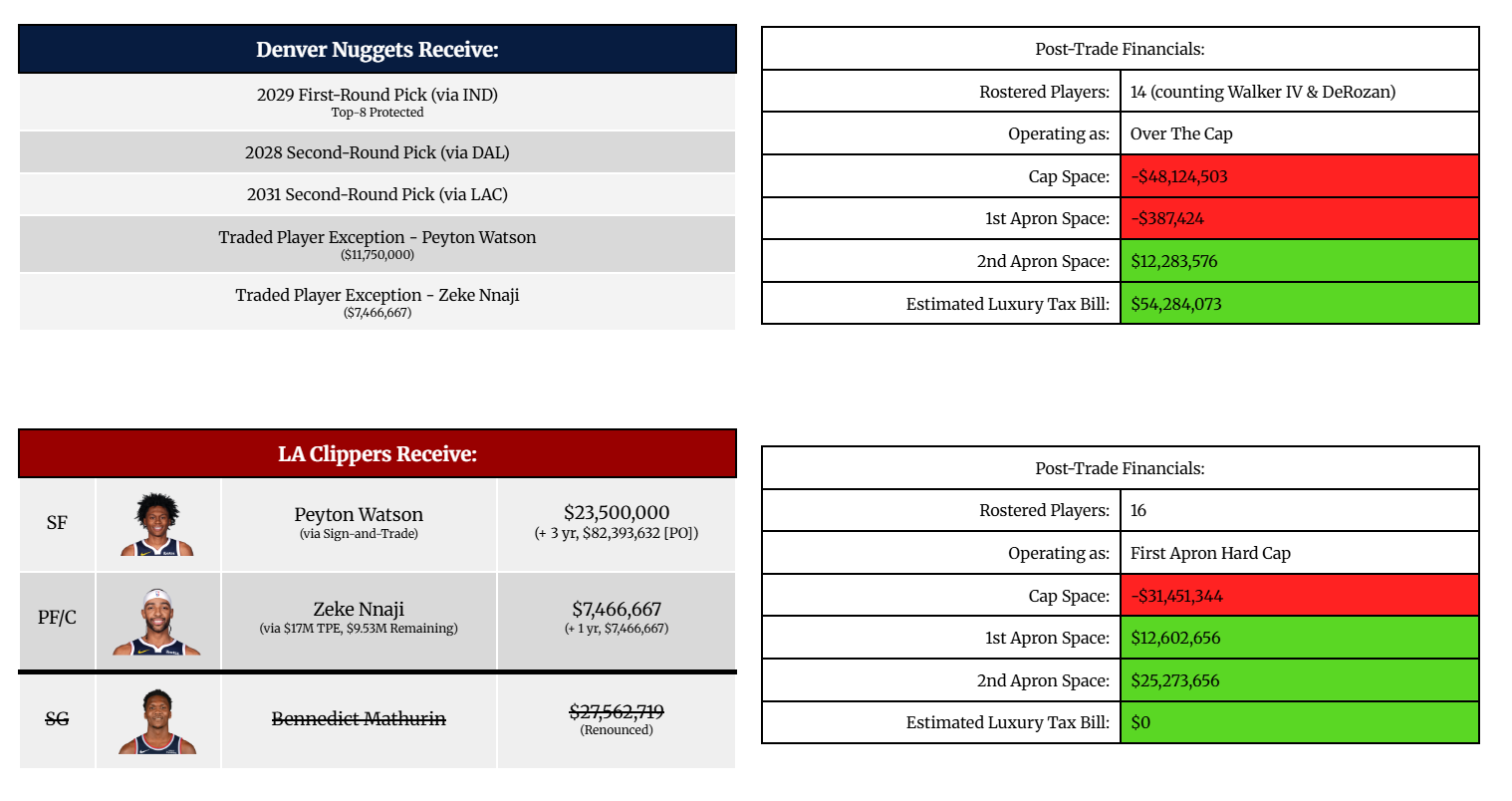
There is a strong possibility that Denver’s primary goal in any Peyton Watson sign-and-trade would be to offload Zeke Nnaji’s contract, take back little to no salary in return and acquire additional draft capital. If that is indeed the case, the Clippers would have a difficult time satisfying all three demands– at least within a two-team framework. The same may be true for other interested teams. Atlanta, Cleveland and Milwaukee would each face their own obstacles in constructing a deal that meets Denver’s potential criteria, even with the involvement of a third or fourth team. So there is an argument that, if this is the priority, that LA’s package is as good as any other. The question, then, is not necessarily whether the Clippers can put together a competitive offer, but whether they are willing to pay the price required to do so.
Remember when I said “the easiest deal is usually the one that gets done”? This is one of those deals that can be perceived as easy because there’s one-team ‘selling out’ to make the trade happen. In this hypothetical trade the LA Clippers are:
- Renouncing Bennedict Mathurin’s cap-hold, allowing him to potentially walk away for nothing with only the $5,477,000 Bi-Annual Exception to offer.
- Taking on Zeke Nnaji’s 2-year, $14,933,334 contract.
- Giving up a first-round pick.
- Giving up two second-round picks.
- Creating two Traded Player Exceptions ($11.75M and $7.5M) for Denver.
The Clippers’ front office has placed a premium on the few remaining assets at its disposal and has consistently shown an ability to negotiate favorable deals. Regardless of how you view Mathurin as a player or what you believe his long-term ceiling may be, it is difficult to envision Los Angeles allowing him to walk for nothing while simultaneously surrendering additional value in a sign-and-trade for Peyton Watson.
As is usually the case, there are multiple alternative paths that the Clippers could go down. For example, the Clippers could choose to prioritize keeping Mathurin, but that too may come with its own considerable cost. Los Angeles would instead need to move Derrick Jones Jr. and either Kris Dunn or Isaiah Jackson into another team’s traded player exception. The only teams with exceptions large enough to absorb both Jones Jr. and Dunn or Jackson are Oklahoma City ($17,722,222), Milwaukee ($25,456,566), Boston ($27,678,571), Memphis ($28,872,920) and Charlotte ($40,770,520). However, they could be sent separately to third and fourth teams with exceptions large enough to absorb them respectively.
Los Angeles could potentially recoup some draft capital by dumping Jones Jr. and Dunn if those are the two players that get sent out to make room for Watson, but that hardly changes the broader equation. At that point, they would be sacrificing two starting-caliber role players, absorbing a negative-value contract and giving up some of their own draft capital — all to complete the Watson deal. Whether the cost is renouncing Mathurin or moving Jones Jr. along with Dunn or Jackson, the price is simply too steep for Los Angeles to seriously consider.
There are three-team frameworks as well where LA could sign-and-trade Mathurin into another team’s cap space for draft capital in order to keep Jones Jr. and Dunn while still acquiring Watson and Nnaji, but I feel that such a move would be unlikely given Mathurin’s lack of suitors around the league. I cannot imagine there is a team out there willing to sign Mathurin to his preferred contract while also giving LA the type of draft capital they’d require to consider moving him.
OPTION 2: Denver Attempts To Win-Now While Minimally Slashing Their Expected Luxury-Tax Bill; LA Commits To Youth And Retaining Their First-Round Picks
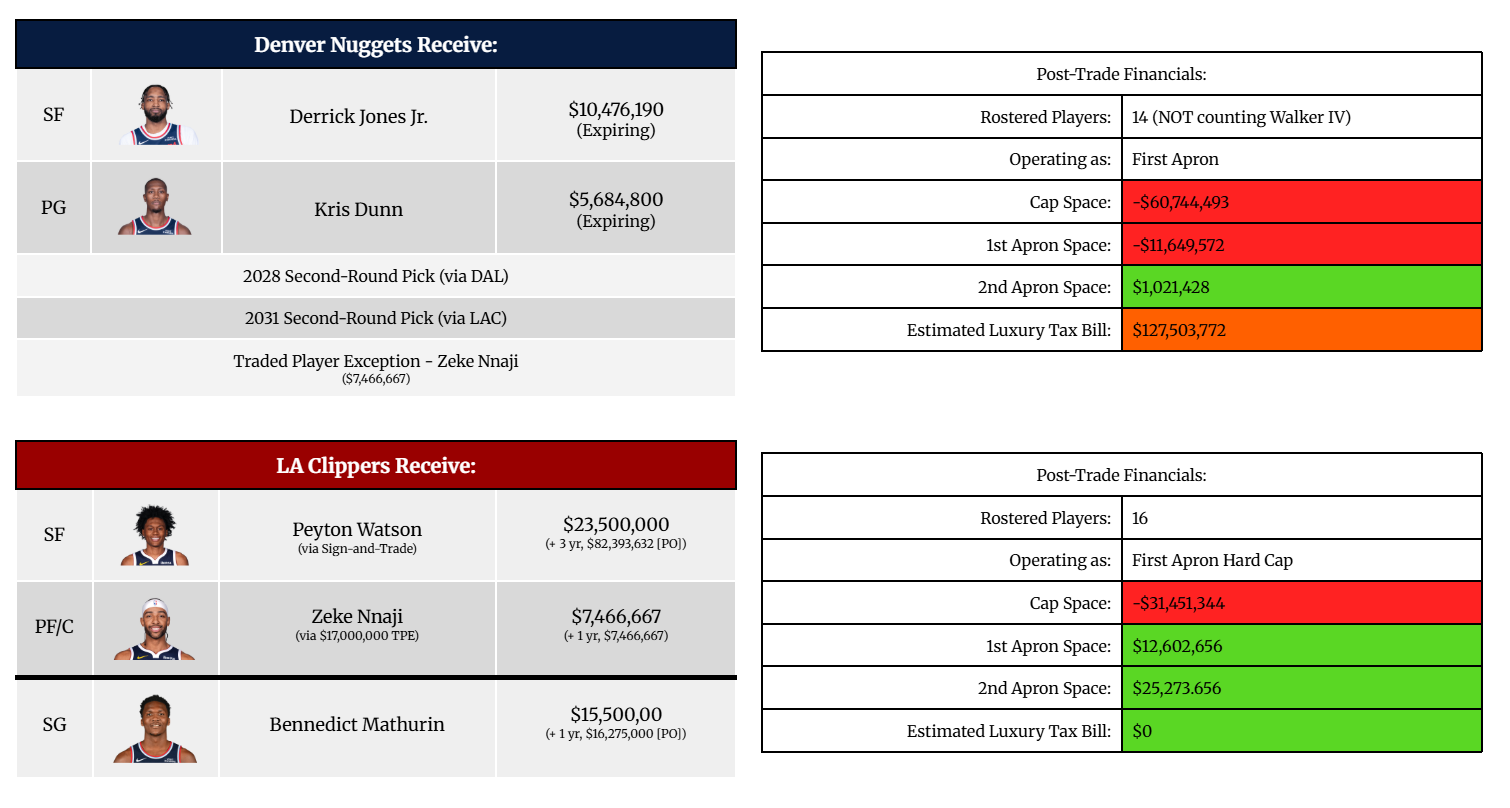
As with the previous trade, Los Angeles does Denver a favor by absorbing Zeke Nnaji’s contract into its $17 million traded player exception, creating a new TPE of equal value for the Nuggets. The difference here is that Denver decides it cannot justify losing a key young rotation player without receiving meaningful talent in return, especially while Nikola Jokić remains unsigned to an extension.
Ownership may have little appetite for the roughly $230 million luxury-tax bill that could come with re-signing Watson, keeping Nnaji and guaranteeing Walker IV, but a tax bill closer to $130 million could be far more palatable if it also allows the Nuggets to remain competitive. Denver would still be paying a substantial tax bill, but the financial burden would be a one-year commitment. Derrick Jones Jr., Kris Dunn and Cameron Johnson would all be on expiring contracts, giving the Nuggets a clear path to significantly reduce their payroll and luxury tax the following offseason.
This deal would allow Denver to turn a negative-value contract in Nnaji and an unproven young player in Watson into two established, starting-caliber veterans in Jones Jr. and Dunn, all while cutting its projected luxury-tax bill nearly in half. The two second-round picks would be an added bonus for a Nuggets team that currently controls just four second-round selections over the next seven years.
This deal would also make sense for Los Angeles. The Clippers would be losing two important defensive contributors, particularly at the point of attack, but the move would significantly improve the roster’s average age. Derrick Jones Jr. and Kris Dunn, despite their elite defensive ability, will turn 30 and 33 years old, respectively, during the 2026-27 season, and their time with the Clippers may be approaching a natural endpoint.
In return, Los Angeles would add a 25-year-old backup forward in Zeke Nnaji and a 23-year-old two-way wing in Peyton Watson, while maintaining the ability to retain its own 24-year-old guard in Bennedict Mathurin. Just as importantly, the Clippers would accomplish all of that without sacrificing any of their future first-round draft capital.
Both teams would be committing to a clear direction in this deal, which is why I believe it is at least somewhat realistic for both sides. The biggest question is whether Kroenke would be willing to stomach a nine-figure luxury-tax bill, even if that financial burden lasts for only one season. There is also reason to be skeptical that Los Angeles would willingly part with both of its elite perimeter defenders.
If Jones Jr. and Dunn are gone, who in the starting lineup would assume their usual responsibilities? Would the Clippers trust rookie guard Keaton Wagler with that assignment right off the bat? Or would Watson, after signing a deal worth around $100 million, be expected to defend the opposing team’s best perimeter player every night while also being the second or third offensive option? Those are significant questions for a Clippers team that would be getting younger and more talented, but also sacrificing some of the role clarity and defensive buy-in that comes with veterans like Jones Jr. and Dunn. Personally, I believe LA and Denver would both do this deal.
OPTION 3: Denver Maximizes Luxury-Tax Savings While Still Acquiring Starting-Caliber Role Player; LA Keeps Dunn And Retains The Ability to Re-Sign Mathurin; Third Team Takes on Isaiah Jackson For Two Second-Round Picks
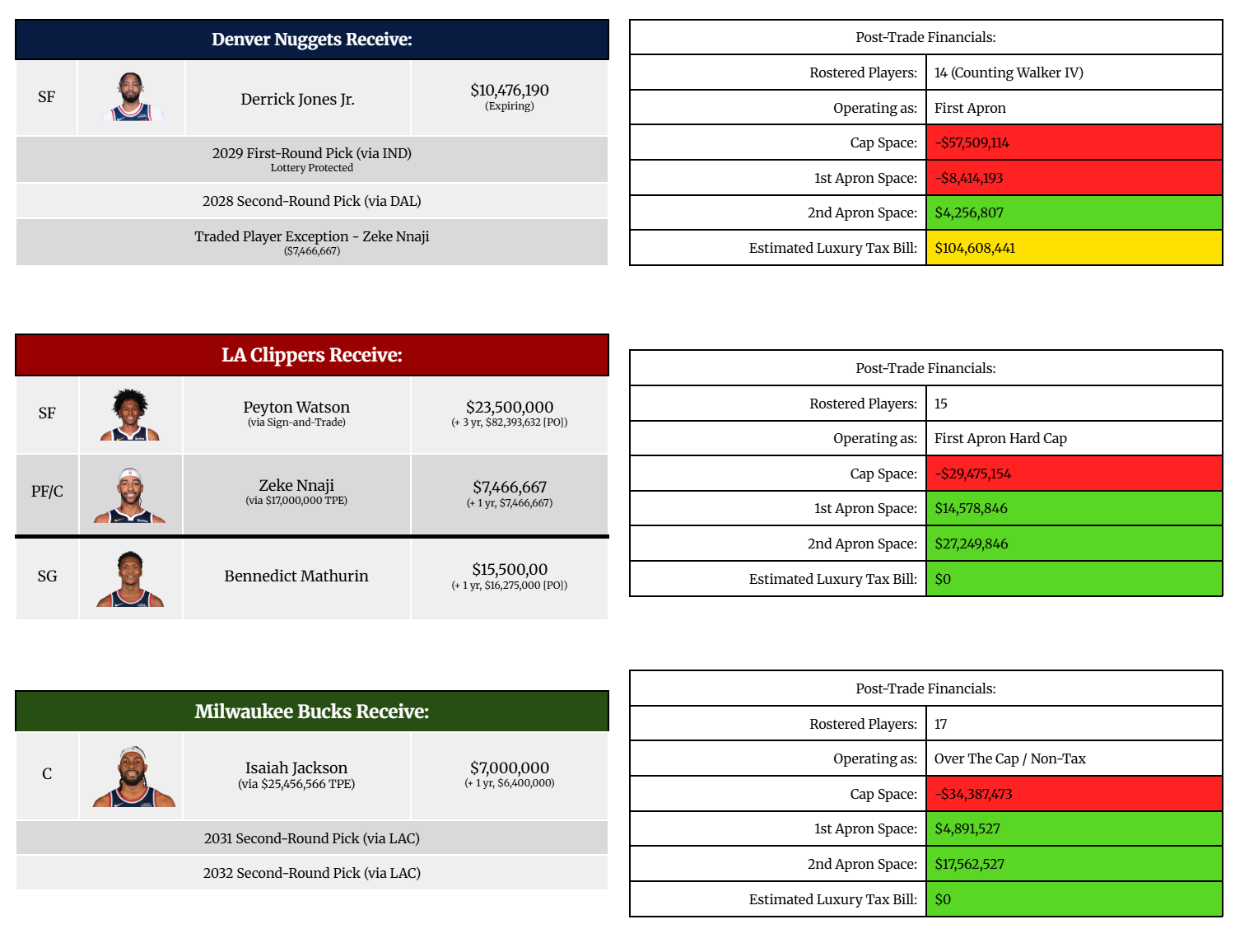
There will probably be Nuggets fans who prefer the previous deal to this one, and I don’t blame them. Ultimately, the question comes down to how much Kroenke is willing to pay to keep Denver competitive. If his priority is minimizing the luxury-tax bill as much as possible, the first deal makes the most sense. If he is unwilling to stomach a tax bill approaching $230 million but could live with one closer to $130 million in exchange for keeping the roster more competitive, the second deal becomes far more appealing. And if Kroenke wants to strike a balance between both options then this deal may represent the most realistic middle ground.
Derrick Jones Jr. would immediately have an opportunity to compete for a starting role alongside Jamal Murray, Cameron Johnson, Aaron Gordon and Nikola Jokić, while giving Denver a much-needed boost in perimeter defense. The additional breathing room below the second apron would also give the Nuggets greater in-season flexibility to make further moves. That could include packaging the first-round pick and/or second-round pick acquired in this deal as part of a larger move at the trade deadline.
Los Angeles would manage to acquire Peyton Watson and essentially swap Isaiah Jackson’s contract for Zeke Nnaji’s deal. The Clippers would still be giving up meaningful value in the process: Derrick Jones Jr., a lottery-protected first-round pick and three second-round picks. That is a significant price, but it allows LA to keep Kris Dunn as a veteran presence and mentor in the locker room while maintaining the flexibility needed to bring Mathurin back.
I used the Milwaukee Bucks as the hypothetical third team, but it could realistically be any team with the flexibility to absorb Isaiah Jackson into a traded player exception, provided its operating threshold allows it. Milwaukee taking on Jackson would not be unrealistic, either, despite the Bucks also being a potential suitor for Watson. If this is ultimately Denver’s asking price, Milwaukee may be reluctant to meet it.
The Bucks are in the midst of a rebuild following the Giannis Antetokounmpo trade and would justifiably balk at the idea of giving up one of their more talented young players, such as Jaime Jaquez Jr. or Ryan Rollins, along with a first-round pick — even a protected one — for Watson. That becomes an even tougher sell if Milwaukee would then need to make a subsequent move, such as dumping AJ Green, to create enough room below the first-apron hard cap to absorb Watson into its $25 million traded player exception.
Final Thoughts
Los Angeles has leverage in these negotiations, but so does Denver, and neither side should expect to dictate the terms entirely. The Clippers cannot expect to fleece the Nuggets, but they also cannot allow themselves to be pressured into an overpay at the beginning of what could be a multi-year retool, particularly as the organization positions itself for maximum cap flexibility in the summer of 2028.
Committing more than $100 million to Watson over the next four years while surrendering multiple draft assets and potentially valuable veterans is the type of gamble LA can only justify if it is convinced that the production he showed during his extended opportunity without Jokić was real and sustainable. LA would need to believe Watson may one day become the same caliber of player as Jaden McDaniels or Jalen Johnson. Paying a premium only for Watson to ultimately become a slightly better version of Jonathan Kuminga or Jabari Smith Jr. would be a costly misstep — especially when that same salary flexibility and collection of assets used to acquire him could have hypothetically helped the Clippers pursue the next disgruntled superstar to hit the market in the next two Summers. Anthony Edwards, anyone?